
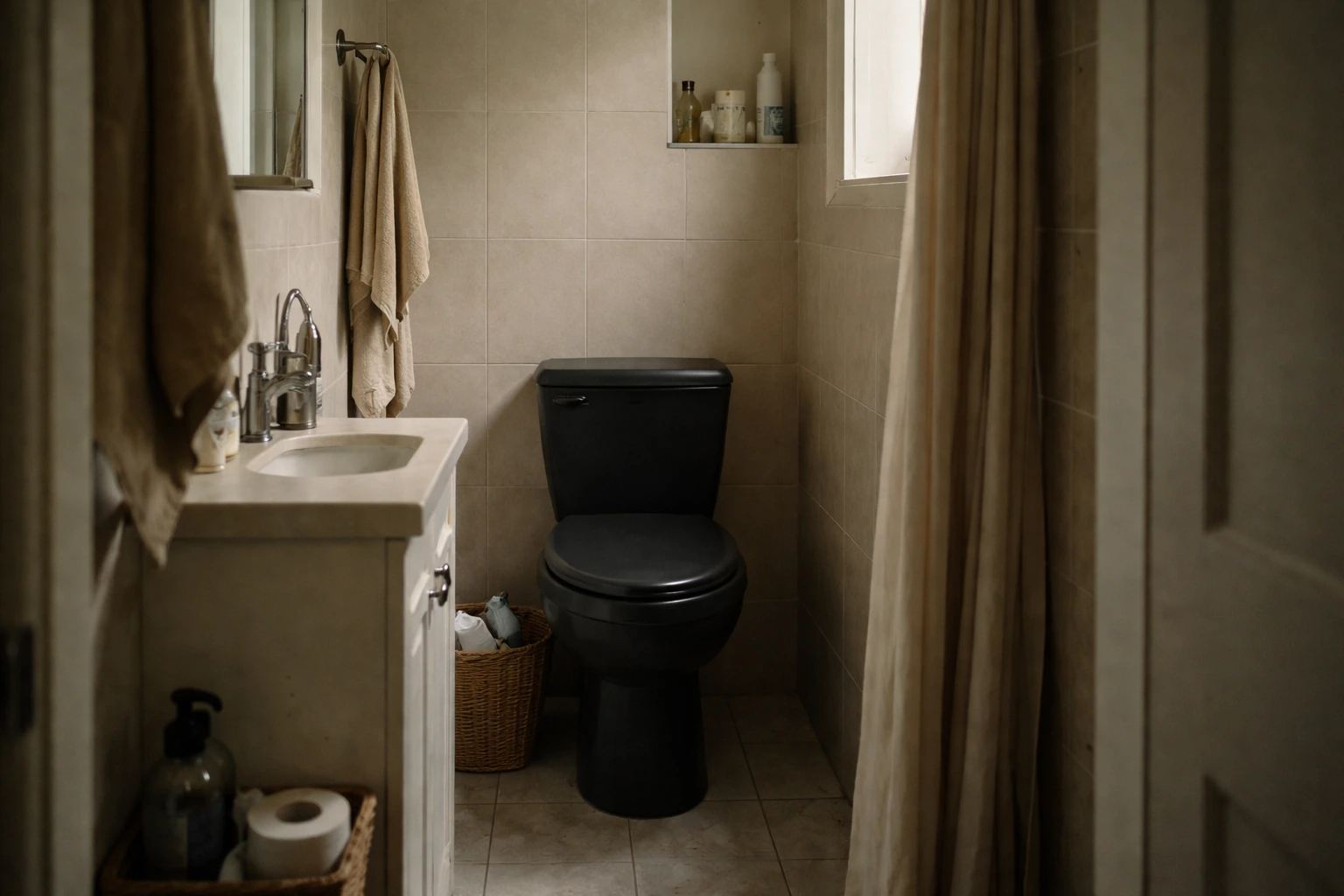
In a small bathroom, every surface works harder. There’s less space to absorb visual noise, fewer places for the eye to rest, and little margin for things that demand attention.
This is where black toilets tend to feel heavier than expected. Not because they’re impractical, and not because they’re unsanitary in a hygienic sense — but because their visual behavior takes up a disproportionate amount of mental space.
What feels manageable in a larger bathroom can quietly become exhausting once the room gets smaller.
Small Bathrooms Amplify Everything
In tight spaces, the eye has fewer escape routes. Fixtures sit closer together. Reflections overlap. Light bounces repeatedly off the same surfaces.
White fixtures tend to soften under this pressure. They blend, reflect evenly, and allow the room to feel more continuous than it actually is.
Black fixtures behave differently. They create contrast, define edges sharply, and hold the eye in place. In a small bathroom, that contrast doesn’t stay contained — it dominates.
Why Black Toilets Feel Visually “Heavy”
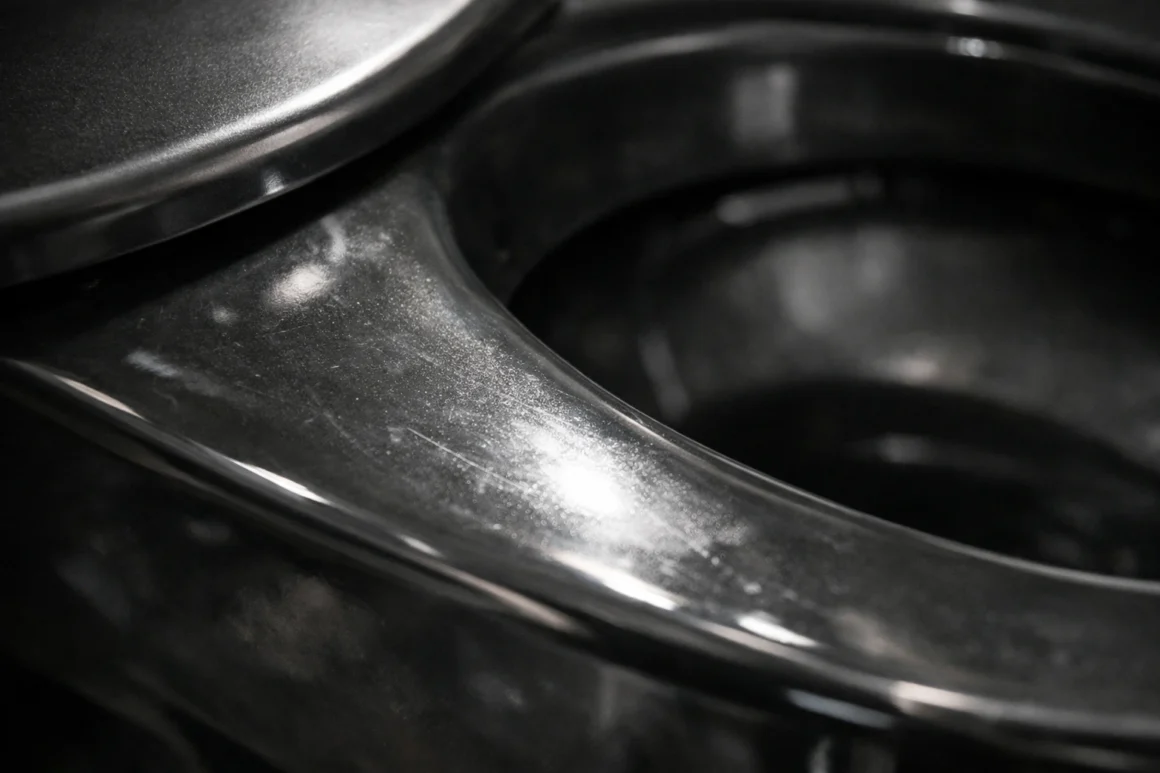
Dark surfaces carry visual weight. They stop light instead of diffusing it, which makes them feel more solid, more present, and harder to ignore.
In a compact bathroom, a black toilet often becomes the darkest object in the room. That automatically turns it into a visual anchor, whether you want it to be or not.
Once a fixture becomes an anchor, the room starts orbiting around it. Every mark, reflection, or water trace feels more noticeable because the eye keeps returning to the same place.
The Problem Isn’t Cleaning — It’s Resolution
In small bathrooms, tasks need to resolve quickly. You want to clean, leave, and mentally close the loop.
Black toilets interrupt that closure. Even after wiping the surface, the result can feel temporary. Light shifts. Glare changes. A faint mark reappears.
The space never quite settles. Not because it’s dirty — but because it keeps asking to be checked again.
That repeated pull on attention is what gives the fixture its weight. The effort isn’t physical. It’s attentional.
Shared and Rental Bathrooms Feel It First
Small bathrooms are often shared. Cleaning schedules vary. Lighting isn’t always chosen intentionally. Water quality differs from day to day.
Black toilets expose all of that. They don’t tolerate inconsistency well, and they don’t hide environmental imperfections.
In these settings, the toilet becomes a constant reminder of things you can’t fully control — which adds tension even when no one can point to a specific problem.
When a Black Toilet Can Work in a Small Space
Black toilets aren’t impossible in small bathrooms, but they demand a narrow set of conditions.
Warm, diffuse lighting. Matte finishes that reduce glare. Walls and floors that stay close in tone. Minimal visual clutter.
Most importantly, they work best in homes where visual resets are already routine — where wiping a surface doesn’t feel like reopening a task.
Why White Toilets Feel Lighter by Comparison
White toilets aren’t superior because they’re cleaner. They’re easier because they disappear.
In small bathrooms, that disappearance matters. It allows the room to feel larger, calmer, and more resolved than it actually is.
White surfaces absorb inconsistency instead of highlighting it. They let the brain move on.
The Weight You Feel Isn’t About Style
When people say a black toilet feels “too much” in a small bathroom, they’re usually describing mental load — not aesthetics.
The fixture asks to be seen, checked, and reassessed in a space that doesn’t have room for that kind of attention.
Understanding this difference helps explain why black toilets can feel perfectly fine in larger bathrooms — and quietly exhausting in smaller ones.
In rooms this small, anything that refuses to fade into the background eventually becomes work.
For a broader look at why black toilets often feel unsanitary even when they’re clean, see the pillar article on visual perception and daily use.
Author & Editorial Review
- Author: Perla Irish — design writer covering interior styling, lighting behavior, and practical home organization, with hands-on experience addressing small-space living challenges.
- Editorial Review: This article was reviewed by the Living Bits & Things editorial team to ensure clarity, accuracy, and alignment with our internal quality and helpful-content standards. Learn more about our editorial review process.
Published: January 2026 · Last updated: January 2026

Leave a Reply