
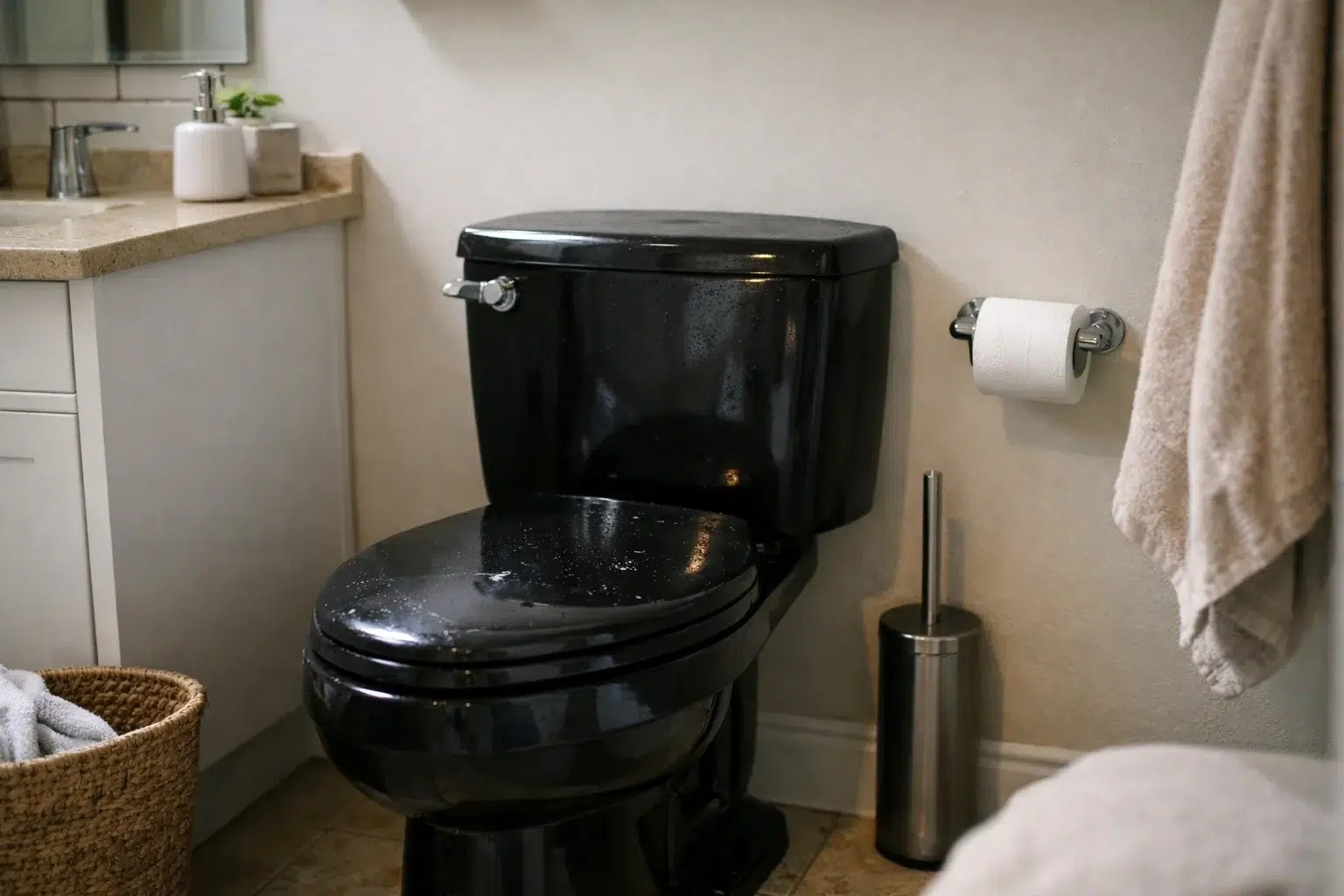
Black toilets are labeled “unsanitary,” but that assumption usually has less to do with hygiene and more to do with how people experience them day to day. They are not inherently unhygienic, but they make residue, water marks, and wear far more visible than white porcelain.
The issue isn’t that black toilets are dirtier. It’s that they ask for more attention. They reveal residue faster, exaggerate contrast under bathroom lighting, and make the space feel harder to keep “finished.”
In small homes, that visual strain directly shapes how comfortable the space feels.
Why Black Toilets Feel “Unsanitary” Even When They’re Clean
Black toilets aren’t unsanitary in a hygienic sense — they’re visually demanding in ways most people don’t anticipate.
Dark surfaces don’t hide residue. They announce it.
Water marks, mineral traces, dust, and even light splashes that disappear on white porcelain remain visible on black finishes. A toilet can be perfectly clean by any functional standard and still look unfinished.
What triggers the reaction isn’t bacteria — it’s the repeated visual interruption. When a fixture repeatedly signals that something is “off,” the brain interprets that as unclean, even if no hygiene issue exists.
Lighting Makes the Difference Worse
Bathrooms rely heavily on overhead and directional lighting. On black ceramic, this creates glare, sharp reflections, and uneven highlights that exaggerate surface variation.
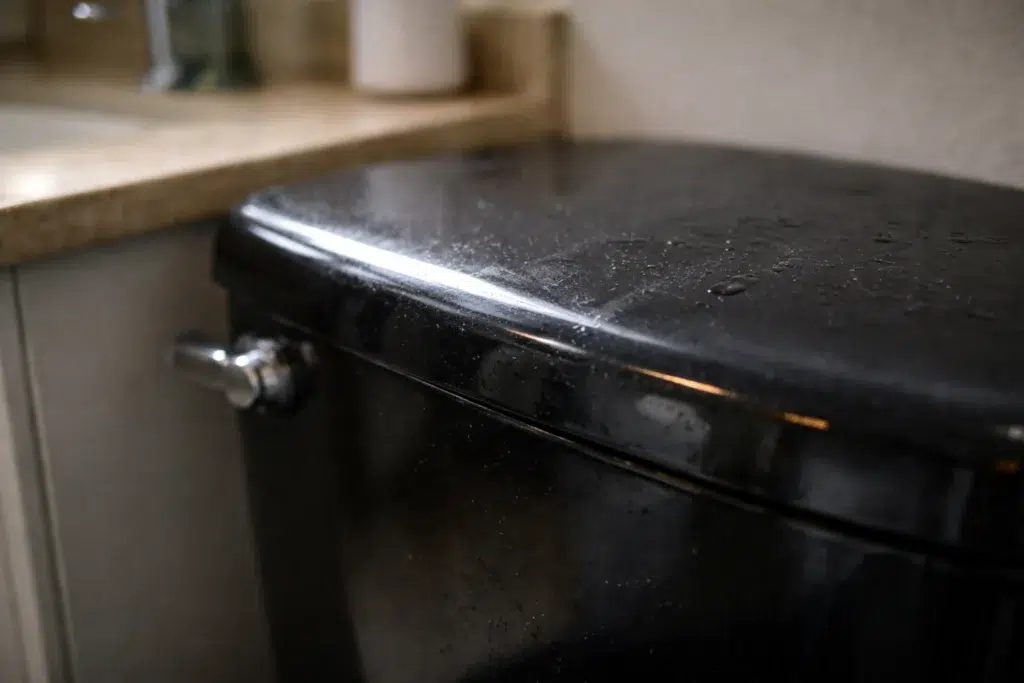
A surface that feels calm in a showroom can feel restless at home — especially under cool LEDs or strong vanity lights. The toilet hasn’t changed. The way light behaves on it has.
That’s why black toilets often require more visual checking, even when cleaning habits stay the same.
A freshly cleaned black toilet doesn’t always register as “done.” Under morning light it may look settled. Later in the day, reflections shift, water marks reappear, and the surface asks to be read again.
Nothing has changed — except the light, the time of day, and the way the surface has to be read again. That repeated re-reading is where the fatigue comes from. Not because the task is difficult, but because it never fully resolves.
Surface behavior matters in other areas of a home as well — especially when preparing materials like concrete before finishing a basement floor. Understanding how surface variation differs from structural movement can prevent cosmetic fixes from masking deeper issues.
This effect becomes even stronger with scale — especially with black toilets in small bathrooms, where visual weight has nowhere to dissipate and attention has fewer places to rest.
Maintenance Isn’t the Problem — Perception Is
Black toilets don’t necessarily require more cleaning. They require more reassurance — visually, not hygienically.
It leads to repeated checks: a quick wipe here, a second glance there. That extra attention adds friction — not because the toilet is hard to clean, but because it never fully fades into the background.
Fixtures that keep drawing the eye make it harder for the room to feel settled.
Once a fixture stops fading into the background, it becomes a low-level obligation. Not a mess to fix — just something that keeps returning to your attention. That quiet obligation weighs more than the cleaning itself.
When Black Toilets Actually Work Well
Black toilets work best in bathrooms designed around low contrast and controlled light. Soft, warm lighting. Matte finishes. Minimal surface clutter. Fewer competing reflections.
In those environments, the toilet blends into a broader visual field instead of becoming a focal point that demands upkeep.
They work best in homes where wiping a surface is part of the normal rhythm, not a chore.
When They Quietly Add Stress
In small bathrooms, rental units, or shared spaces, black toilets often make small inconsistencies harder to ignore. They highlight everything the room can’t control: hard water, inconsistent cleaning schedules, mixed lighting temperatures.
The result isn’t mess — it’s tension. A sense that the space requires ongoing effort just to feel acceptable.
That tension is what people often describe as “unsanitary,” even when hygiene itself isn’t the issue.
A Better Question Than “Is It Hygienic?”
The more useful question isn’t whether a black toilet is sanitary.
It’s whether it supports how the space is actually used — without demanding constant attention. Seeing black vs white toilets in everyday use makes that difference clearer once style fades and daily habits take over.
If you’re exploring how visual friction shows up elsewhere in a home, you may find it useful to read why rigid organization systems often increase mental load instead of reducing it.
In small homes, what matters most isn’t how something looks when it’s clean, but how completely it allows the room to feel resolved afterward.
Author & Editorial Review
- Author: Perla Irish — design writer covering interior styling, lighting behavior, and practical home organization, with hands-on experience addressing small-space living challenges.
- Editorial Review: This article was reviewed by the Living Bits & Things editorial team to ensure clarity, accuracy, and alignment with our internal quality and helpful-content standards. Learn more about our editorial review process.
Published: January 2026 · Last updated: January 2026
Leave a Reply